
Article
How to protect margin in custom automation projects
Margin is not usually lost on the shop floor. It is surrendered months earlier, at the moment the delivery date is agreed.
Executive summary
Most custom automation builders lose margin during quoting, not on the shop floor.
When sales treats the deliveryPeriod as a marketing promise rather than a
hard cost variable, it triggers a systemic financial failure cascade. You cannot protect
projectedMargin until you price schedule compression into your quotes.
Most custom automation builders and job shops share the same frustrating reality. The
floor is busy, revenue looks strong, and the projectedMargin at year end is
dangerously thin.
When a custom machine project loses money, management usually blames execution. The assumption is that engineering took too long in CAD, or that assembly was inefficient. In high mix low volume work, that is rarely where the money went.
It went months earlier. When sales is measured only on salesAmount and
agrees to an aggressive deadline to win the PO, it starts a predictable cascade. Call it
the marginDestructionLoop.
Delivery date is a cost variable, not a marketing promise
The loop starts the moment a highly customized project is sold on a standard lead time.
Fixing the price while compressing the deliveryPeriod is unpriced financial
risk. You are absorbing the cost of compression internally instead of quoting it.
1. The compression of designLabor
An aggressive PO hits the engineering bottleneck immediately. The shop is already busy
pushing out the last set of rushed orders, so the new project queues. By the time
designLabor actually starts, the schedule is behind. Engineers rush the
architecture, standard tolerances get skipped, and incomplete drawings reach the floor.
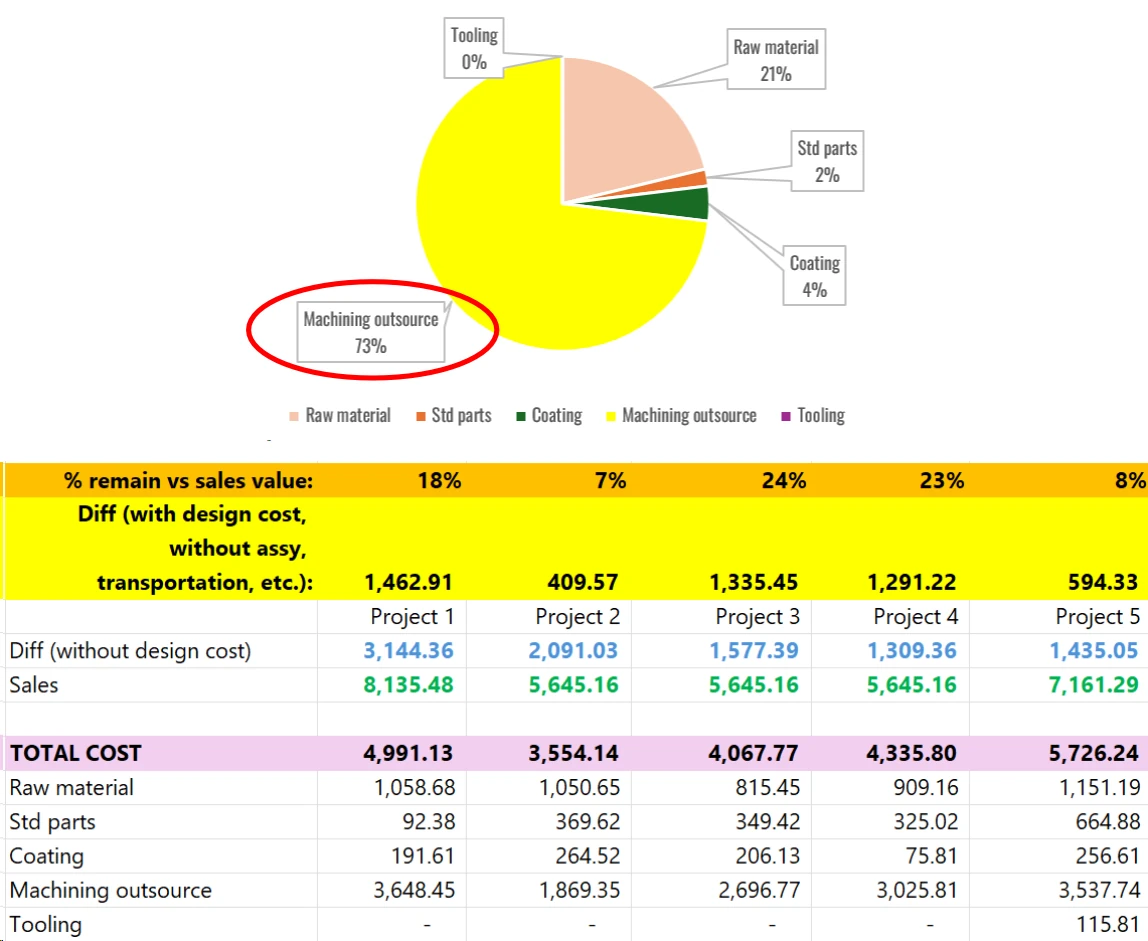
2. The machiningOutsource premium
Because the design was released late, the internal fabrication window has effectively
vanished. To hit the promised date and avoid penalties, production hits the panic button.
Instead of machining internally at a controlled cost, the work goes to external vendors on
expensive 5-axis capacity with expedite fees. machiningOutsource cost
skyrockets.
The anatomy of the marginDestructionLoop
Mapped out, the collapse is entirely predictable. It is a structural failure, not a people problem:
- Aggressive PO. A short
deliveryPeriodis accepted without confirming capacity. - Engineering conflict. Backlog delays the actual design start.
- Late release. The fabrication window shrinks sharply.
- Panic sourcing. Heavy
machiningOutsourcepremiums are triggered to save the schedule. - Margin collapse. A two digit margin drops to single digits before the first bolt is turned.
If customers demand a compressed schedule, the market says they pay for that speed. Build your project acceptance gates to carry hard risk variables, and separate standard cost from expedite premium.

The Sheet Mechanic
The field manual behind these tools. Scope creep, vendor management, design reviews and the gap between the perfect design and the real world.
Get the bookAs an Amazon Associate I earn from qualifying purchases. Full disclosure.